Rotary Die Cutting.
For ultra-high-volume production runs and continuous manufacturing, rotary die cutting is the most efficient conversion method available. Unlike flat-bed processes that move up and down, rotary cutting uses a cylindrical die that rotates at high speeds. As the material passes between the rolling die and an anvil, parts are sheared out in a continuous, seamless motion.
- Rotary die cutting uses a cylindrical die that rotates against an anvil, shearing parts out of a moving web of material in a continuous, seamless motion.
- It suits ultra-high-volume runs of roll-fed, thin-gauge materials like PTFE, Mylar, Kapton, foil, polyethylene, UHMW, and adhesive-backed rubbers and foams.
- In a single pass we laminate, die cut, and strip away the waste matrix, kiss-cutting or through-cutting parts with repeatable dimensional stability across the full roll.
Request a quote for rotary die cutting.
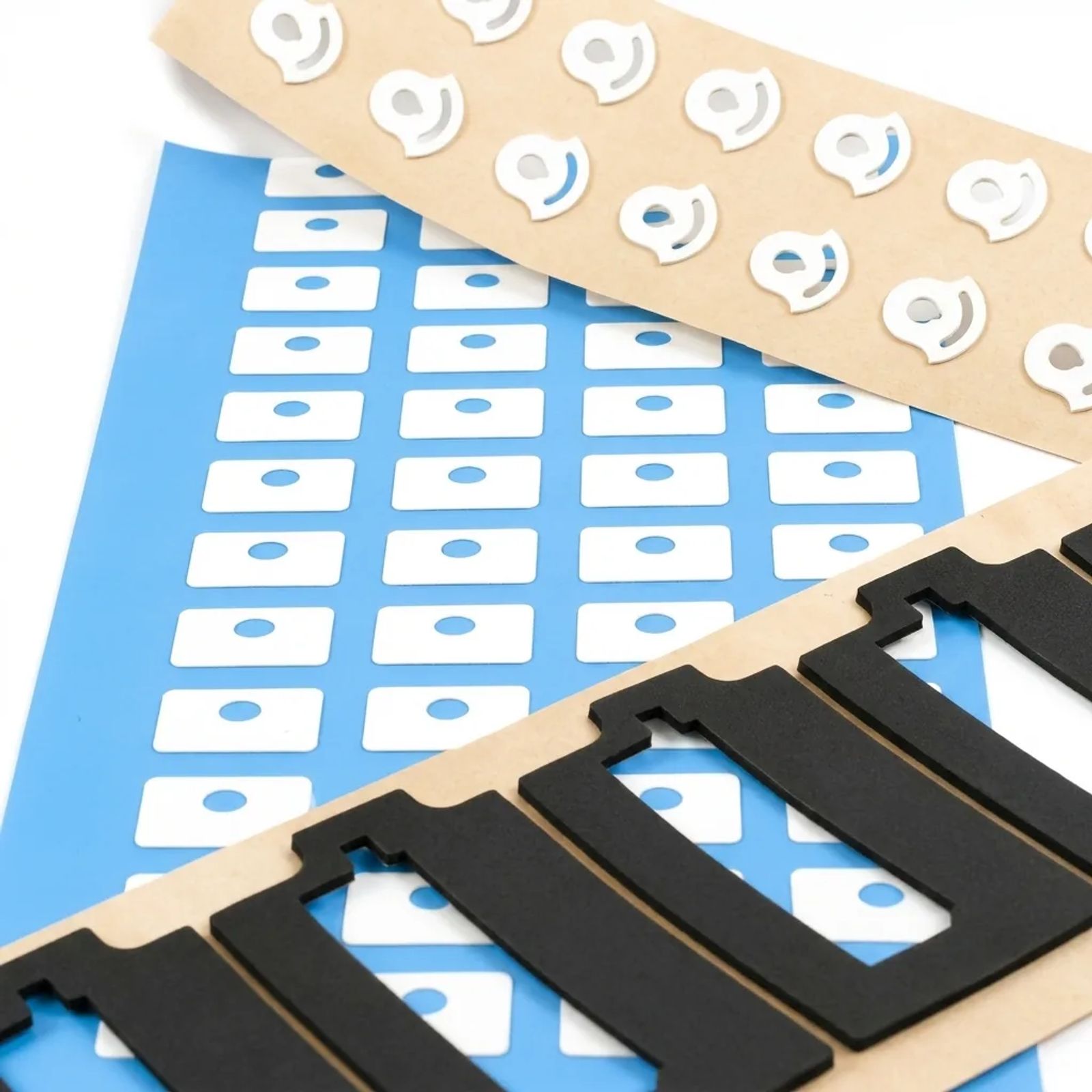
Benefits of rotary die cutting.
Rotary die cutting offers unparalleled speed and consistency, making it the industry standard for large-scale industrial projects:
Unmatched Production Speed. Because the process is continuous rather than reciprocal (up and down), rotary presses can run at incredibly high speeds. This makes it the most cost-effective method for orders reaching into the millions of pieces.
Inline Converting Capabilities. Rotary cutting is uniquely suited for multi-stage processing. In a single pass, we can laminate materials, die cut the shape, and remove the waste (slugs), significantly reducing handling time and labor costs.
High Precision and Repeatability. The fixed circular geometry of a rotary die ensures that every part is identical. Once the press is dialed in, it maintains extreme dimensional stability over the entire length of the material roll.
Efficient Waste Management. Rotary systems are designed to automatically strip away the matrix (the leftover material) as the parts are cut. This on-the-fly waste removal keeps production lines clean and moving at peak efficiency.
Ideal for Thin Materials. The rolling action of the die is gentler on thin substrates than the heavy impact of a flat-bed press, making it perfect for delicate films and adhesive-backed materials that need to be kiss-cut.
Tight-tolerance tooling and shielding gaskets.
We run rotary presses with magnetic plate tooling or engraved, machined dies, cutting most non-metallic materials with pressure-sensitive adhesive on one or two sides.
Adhesive-backed and kiss-cut parts. We laminate 3M adhesives and tapes, including hypoallergenic adhesives for medical applications, and supply parts kiss-cut so they peel and stick for faster assembly.
EMI/RFI shielding gaskets. Rotary cutting handles conductive elastomers for EMI and RFI shielding, including conductive and wire-mesh silicone and metal-wrapped conductive foam.
Tight tolerances at volume. Magnetic plate and engraved die tooling hold tight, repeatable tolerances across long production runs, keeping dimensional stability consistent from the first part to the last.