Lathe Cut Washers.

Cannon Gasket lathe-cuts washers in EPDM, Neoprene, silicone, Nitrile, Viton, FDA, and USP Class VI grades under ISO 9001 controls. Send OD, ID, thickness, material, and quantity. We quote pricing, tooling cost if needed, and production lead time.

Quick facts about Lathe Cut Washers
  • When flatbed die cutting cannot hold the OD, ID, and thickness tolerance a bolted joint needs, lathe cutting takes over.
  • Automotive, aerospace, medical, industrial, and fluid-handling assemblies all spec lathe cut washers for tight-tolerance cylindrical seals.
  • Tube stock gets extruded, then turned on a CNC lathe. The result is a flat, square-edge ring in rubber or plastic.
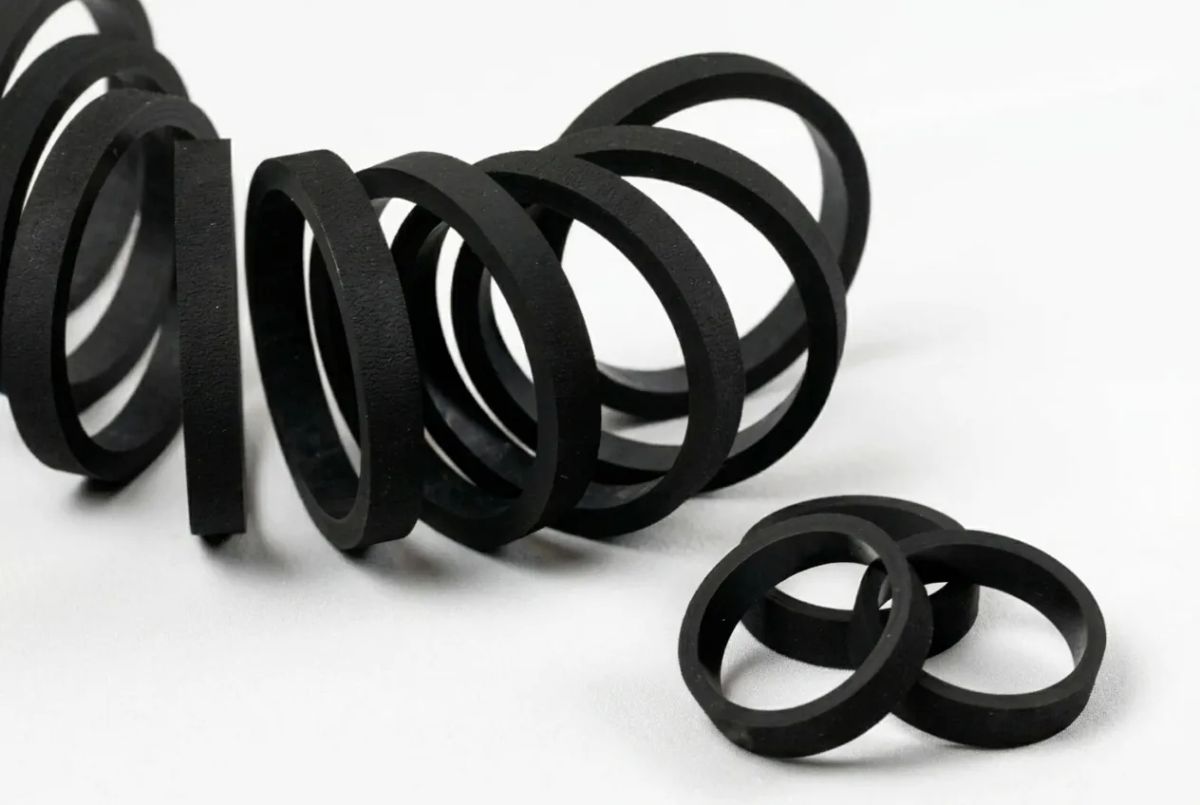
Assorted sizes of black lathe-cut rubber washers grouped on a soft gray background at Cannon Gasket.
Get pricing

Request a quote for custom lathe cut washers.

Why choose lathe-cut washers?

Lathe cut washers are often chosen as an alternative to O-rings because of their square wall and superior sealing capabilities. Lathe cutting is a precision process for producing washers, O-rings, and seals from tube or rod stock. By turning the material on a precision lathe and parting off to thickness, we achieve tighter ID, OD, and thickness tolerances than flatbed or rotary die cutting, and eliminate the parting lines associated with molded O-rings.

Lathe cut washers are manufactured from extruded tube, mandrel built or molded rubber tube. Unlike die-cutting calendared rubber, lathe cutting gives you the ability to cut parts that otherwise would be too thick to die-cut, or parts requiring non standard thickness that would not be achievable from calendared rubber.

When to specify lathe-cut over die-cut

Lathe cutting is the preferred process when tight ID/OD concentricity is required, when parting lines are unacceptable, or when the cross-section tolerance is tighter than flatbed cutting can achieve. It is also well-suited to low-to-medium volume production runs where tooling cost for a molded O-ring is not justified.

Lathe-cut washer tolerances

Lathe-cut washers and seals can be produced to tolerances of ±0.001" to ±0.005" on OD, ID, and thickness depending on material. This is significantly tighter than typical die-cut tolerances and approaches machined-part precision.

Applications & Industries
Hydraulic sealsO-ring groovesStatic sealingPrecision instrumentsMedical devicesAerospace
Marking & Packaging

Pad printing. Individual parts can be labeled for identification purposes. We have the ability to pad print your part number, identification marking, or company name on each gasket. Various colors of ink are available. Marking per customer specifications or MIL-STD-130.

Packaging. Parts can be bagged and tagged into specific quantities and labeled with P/N or any required information, with the capability to meet any specific packaging or labeling requirements.

Frequently Asked Questions

Common questions about lathe-cut washers.

Are you ISO 9001 certified?
Yes, ISO 9001:2015 certified. Documented quality management covers incoming material verification, in-process inspection, calibrated measurement, final inspection, non-conformance handling, corrective action, and full lot traceability. AS9100-ready for aerospace, with MIL-spec and FDA 21 CFR 177.2600 / USP Class VI grades available on request.
What is a lathe-cut O-ring?
A lathe-cut seal is turned from tube stock instead of molded. Square cross-section instead of round. Lower tooling cost and often better dimensional stability than molded O-rings at low-to-mid volume. See /lathe-cut-washers/ for details.
What tolerances can you hold on lathe-cut parts?
Standard OD/ID tolerance is ±0.010 inch to ±0.015 inch, with thickness held to ±0.002 inch. We can hold ±0.005 inch on ID and OD on select compounds, and as tight as ±.001 inch on critical dimensions, with first-article inspection.
When should I specify a lathe-cut washer instead of a molded O-ring?
Lower tooling cost on short runs, tighter dimensional control on thickness, and flat sealing faces that help on grooved or machined seats. Molded O-rings are still cheaper at high volume in a standard AS568 size.
Which compounds can you lathe-cut?
Any material supplied as extruded tube: Buna-N, EPDM, Silicone, Viton, Neoprene, SBR, and specialty compounds like Fluorosilicone or Aflas. PTFE and other fluoropolymers on request.
How fast do you return a quote?
Most RFQs come back within one business day. Simple profile updates to an existing tool quote same-day. Send a drawing, DXF, or competing part number and our engineering team reviews material, tolerance, and volume before pricing.
What is the minimum order quantity?
Minimums depend on the part and material. We cut prototype and first-article quantities for engineering evaluation, then scale up to production volumes from the same tooling. For high-volume programs we run JIT, VMI, and Kanban replenishment out of Fontana, California.
What should I send with an RFQ?
Ideal: a drawing or DXF, material spec (or compound family), estimated annual volume, and any regulatory callouts (FDA, USP Class VI, AS9100, MIL-spec). If you only have a sample or a part number from a competing supplier, send that and we will reverse-engineer the spec before quoting.
What are typical lead times?
Prototype and first-article parts usually ship in 5-10 business days. Production runs from existing tooling are 2-3 weeks depending on volume and material lead time. Rush and expedite options available on a case-by-case basis.
Need custom lathe cut washers?
From prototype to production, any material, any volume.
ISO 9001 CertifiedAS9100-ReadyMIL-Spec CompatibleFDA / USP Class VIEst. 1971ISO 9001 CertifiedAS9100-ReadyMIL-Spec CompatibleFDA / USP Class VIEst. 1971ISO 9001 CertifiedAS9100-ReadyMIL-Spec CompatibleFDA / USP Class VIEst. 1971ISO 9001 CertifiedAS9100-ReadyMIL-Spec CompatibleFDA / USP Class VIEst. 1971