Rubber Gasket Materials.

Ten standard rubber compounds, from Buna-N and EPDM to Viton and silicone, die-cut into custom gaskets matched to your fluids, temperature range, and regulatory requirements.

Quick facts about Rubber Gasket Materials
  • Ten standard rubber gasket materials, from Buna-N and EPDM to Viton and silicone
  • Custom rubber gaskets die-cut to your drawing, any volume from prototype to production
  • Compounds matched to your fluids, temperature range, and regulatory requirements
  • ISO 9001 certified, manufacturing in Fontana, CA since 1971
Materials
10 compounds
Tooling
In-house dies
Certified
ISO 9001
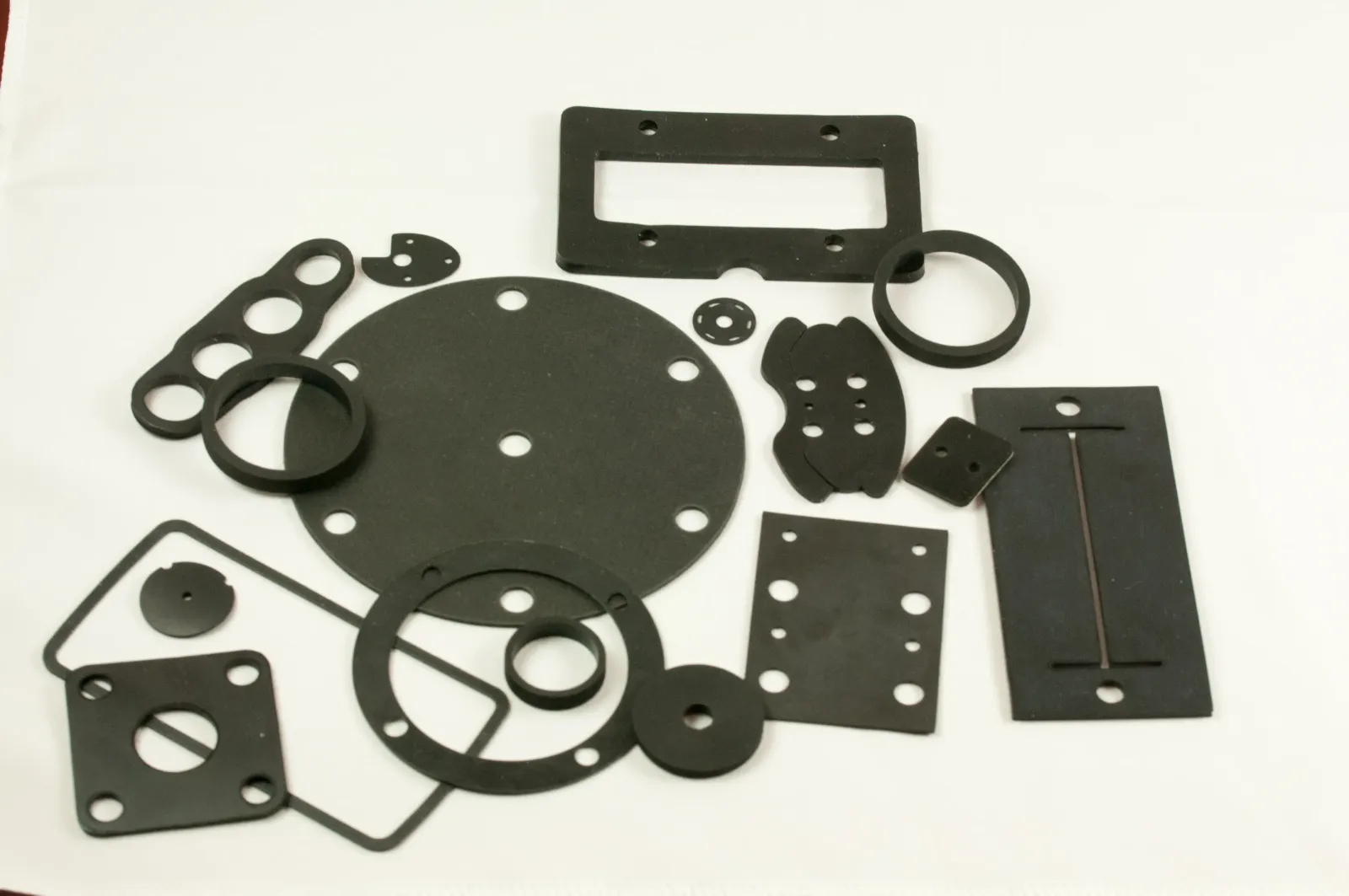
Rubber Gasket Materials gaskets, die-cut close-up
Get pricing

Request a quote for rubber gasket materials.

Rubber Gasket Materials

What rubber gasket materials do.

Rubber gasket materials are elastomer compounds engineered to seal against fluids, gases, weather, and vibration, with each compound tuned for a specific combination of chemical exposure, temperature range, and regulatory requirement. Cannon Gasket stocks ten standard rubber compounds, including Buna-N (Nitrile), EPDM, FDA and medical grade, fluorosilicone, neoprene, polyisoprene, polyurethane, SBR, silicone, and Viton, plus Santoprene, military-spec grades, and custom blends on request. The right material is the one matched to what your gasket actually contacts in service, and the descriptions below outline where each compound performs best. To learn what a rubber gasket is and how the common types are used, see our guides on understanding rubber gaskets and rubber gasket types and use cases.

Choosing a compound is only half the job. Cannon Gasket converts each material into custom rubber gaskets die-cut to your drawing, holding tight tolerances with precision stamping, kiss cutting, and an in-house die department for rapid turnaround. We add pressure-sensitive adhesive lamination, pad-printed part marking, and bagged-and-tagged packaging, then support production with blanket orders and managed inventory programs. From a single prototype to long production runs, no job is too large or too small, and every order ships from an ISO 9001 certified shop that has been cutting gaskets in Fontana, California since 1971.

Frequently Asked Questions

Common questions about custom gaskets.

Are you ISO 9001 certified?
Yes, ISO 9001:2015 certified. Documented quality management covers incoming material verification, in-process inspection, calibrated measurement, final inspection, non-conformance handling, corrective action, and full lot traceability. AS9100-ready for aerospace, with MIL-spec and FDA 21 CFR 177.2600 / USP Class VI grades available on request.
Can you cut custom gasket profiles?
Yes. Custom steel-rule and rotary tooling is built in-house from your drawing or DXF. Complex profiles, multiple through-cuts, tight bolt patterns, and irregular perimeters are all standard work.
Can you supply PSA-backed gaskets?
Yes. Pressure-sensitive adhesive backing is a standard option on most rubber and fiber gasketing, with either permanent or removable liners. Kiss-cut on liner and through-cut both supported on flatbed and rotary presses.
What tolerances can you hold on gasket dimensions?
Standard die-cut tolerance is ±0.010 to ±0.015 inch on OD and ID, depending on material durometer and thickness. Tighter tolerances are available on select grades and thicknesses. Ask if your drawing specifies something tighter and we will confirm feasibility during the quote.
Which gasket material is right for my application?
Start with temperature range, fluid contact, and regulatory requirements. Buna-N is the default for oil and fuel. EPDM for weather, water, and steam. Silicone for extreme temperature and FDA grades. Viton for aggressive chemicals. Our gasket material selection guide walks through the decision framework.
How fast do you return a quote?
Most RFQs come back within one business day. Simple profile updates to an existing tool quote same-day. Send a drawing, DXF, or competing part number and our engineering team reviews material, tolerance, and volume before pricing.
What is the minimum order quantity?
Minimums depend on the part and material. We cut prototype and first-article quantities for engineering evaluation, then scale up to production volumes from the same tooling. For high-volume programs we run JIT, VMI, and Kanban replenishment out of Fontana, California.
What should I send with an RFQ?
Ideal: a drawing or DXF, material spec (or compound family), estimated annual volume, and any regulatory callouts (FDA, USP Class VI, AS9100, MIL-spec). If you only have a sample or a part number from a competing supplier, send that and we will reverse-engineer the spec before quoting.
What are typical lead times?
Prototype and first-article parts usually ship in 5-10 business days. Production runs from existing tooling are 2-3 weeks depending on volume and material lead time. Rush and expedite options available on a case-by-case basis.
Need custom rubber gasket materials?
Send your drawing or material spec. We quote pricing, tooling, and lead time within one business day.
ISO 9001 CertifiedAS9100-ReadyMIL-Spec CompatibleFDA / USP Class VIEst. 1971ISO 9001 CertifiedAS9100-ReadyMIL-Spec CompatibleFDA / USP Class VIEst. 1971ISO 9001 CertifiedAS9100-ReadyMIL-Spec CompatibleFDA / USP Class VIEst. 1971ISO 9001 CertifiedAS9100-ReadyMIL-Spec CompatibleFDA / USP Class VIEst. 1971