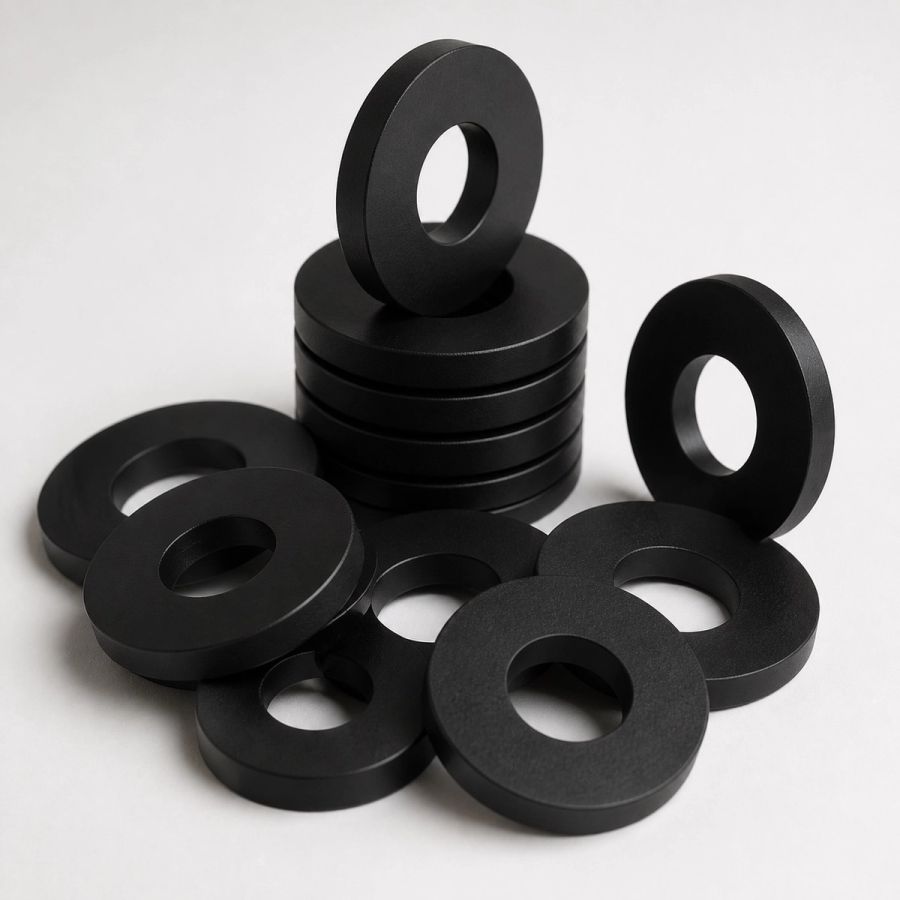
ABS Plastic Washers

ABS (acrylonitrile butadiene styrene) is a tough, impact-resistant thermoplastic widely used in consumer products, automotive trim, and structural applications. Cannon Gasket die-cuts and machines custom ABS washers for impact-resistant structural spacers and economical industrial use.

Highlight
Good impact resistance
Custom ABS plastic washers from Cannon Gasket
Get pricing

Request a quote for ABS plastic washers.

Properties of ABS plastic washers

Cannon Gasket cuts ABS plastic washers to your drawing. Good resistance to water, alcohols, and aliphatic hydrocarbons.

ABS tolerances and customization

Standard dimensional tolerances on ABS plastic washers land around ±0.010" to ±0.015" on OD and ID, depending on material thickness and profile. Tighter tolerances are available on selected grades. Cannon Gasket cuts ABS to custom profiles in-house and matches lead times to your production volume. PSA backing, pad printing, custom packaging, and kitting are all on the menu when you need them.

How ABS Performs

- High impact resistance. - Good rigidity and structural strength. - Easy to machine and paint. - Moderate chemical resistance (not for solvents or acids).

Common Washer Applications

Automotive trim and accessory washers, consumer product assemblies, electronic enclosure spacers, structural fastener washers in indoor applications, and economical impact-resistant industrial washers.

When to Choose Another Material

For higher temperature, polycarbonate or PC/ABS blend. For chemical exposure, PTFE or polypropylene.

Manufacturing Methods

Die-cut and CNC-machined.

Manufacturing, finishing & stocking

Precision & tooling: Capable of holding tolerances as tight as ±.001" on critical dimensions when required, beyond the ±0.010" to ±0.015" standard. Short- and long-run capabilities, with an extensive in-house tooling inventory for rapid turnaround.

Clean room: Cannon Gasket offers clean-environment stamping for medical, FDA, electronic, and scientific applications where a controlled level of particulate is required, with capabilities to meet ISO Class 10,000.

Stocking agreements: Blanket orders, VMI (vendor-managed inventory), JIT (just-in-time), and Kanban replenishment programs.

Pad printing: Pad print your part number, identification marking, or company name in a range of ink colors. Marking per customer specifications or MIL-STD-130.

Packaging: Parts are bagged and tagged in specified quantities and labeled with P/N or any required information. Capability to meet specific packaging and labeling requirements.

Frequently Asked Questions

Common ABS questions.

Are you ISO 9001 certified?
Yes, ISO 9001:2015 certified. Documented quality management covers incoming material verification, in-process inspection, calibrated measurement, final inspection, non-conformance handling, corrective action, and full lot traceability. AS9100-ready for aerospace, with MIL-spec and FDA 21 CFR 177.2600 / USP Class VI grades available on request.
Does nylon washer absorb water?
Yes, standard Nylon 6 and Nylon 6/6 absorb water over time, which slightly expands the part. For long-term water contact specify PTFE, UHMW, or Delrin (acetal) instead.
Which plastic washer is best for electrical isolation?
PTFE, Kapton (polyimide), G-10 fiberglass, and Lexan polycarbonate all have excellent dielectric properties. Kapton and G-10 also hold up to high temperature, useful for transformer and motor applications.
Which plastic washer resists the most chemicals?
PTFE (Teflon) is chemically inert to nearly all industrial fluids, acids, and solvents. UHMW is next for abrasion plus moderate chemical exposure. Nylon handles most oils and fuels but swells in water over time.
Which plastic washer survives the highest temperature?
Kapton polyimide to +500°F continuous, PTFE to +500°F, G-10 fiberglass to +300°F, PEEK higher still on request. Standard nylon and UHMW cap around 200°F.
How fast do you return a quote?
Most RFQs come back within one business day. Simple profile updates to an existing tool quote same-day. Send a drawing, DXF, or competing part number and our engineering team reviews material, tolerance, and volume before pricing.
What is the minimum order quantity?
Minimums depend on the part and material. We cut prototype and first-article quantities for engineering evaluation, then scale up to production volumes from the same tooling. For high-volume programs we run JIT, VMI, and Kanban replenishment out of Fontana, California.
What should I send with an RFQ?
Ideal: a drawing or DXF, material spec (or compound family), estimated annual volume, and any regulatory callouts (FDA, USP Class VI, AS9100, MIL-spec). If you only have a sample or a part number from a competing supplier, send that and we will reverse-engineer the spec before quoting.
What are typical lead times?
Prototype and first-article parts usually ship in 5-10 business days. Production runs from existing tooling are 2-3 weeks depending on volume and material lead time. Rush and expedite options available on a case-by-case basis.
Need custom ABS washers?
From prototype to production, any shape, any volume.
ISO 9001 CertifiedAS9100-ReadyMIL-Spec CompatibleFDA / USP Class VIEst. 1971ISO 9001 CertifiedAS9100-ReadyMIL-Spec CompatibleFDA / USP Class VIEst. 1971ISO 9001 CertifiedAS9100-ReadyMIL-Spec CompatibleFDA / USP Class VIEst. 1971ISO 9001 CertifiedAS9100-ReadyMIL-Spec CompatibleFDA / USP Class VIEst. 1971